Northbridge research lab
An investigation has worked out how an attacker researched a university lab. Model the five reconnaissance steps accurately.
Course › Lesson 1 of 7
Before most attacks there's a period of research. The attacker learns who works where, which technology the target uses, and where the weak points might be. This lesson covers what reconnaissance looks like, how MITRE ATT&CK describes it, why it's so hard to defend against, and how to show it in an attack graph.
Reconnaissance is the attacker gathering information to plan the attack. It is the first stage of the Cyber Kill Chain, and in MITRE ATT&CK it's the Reconnaissance tactic.
Its purpose is to answer questions such as:
Good reconnaissance makes every later stage easier. A phishing email sent to the right person, about the right topic, using the right name, is far more convincing than one sent at random.
Reconnaissance comes in two kinds, and the difference matters to defenders:
Attackers usually start passively and move to active reconnaissance only when they know what they're looking for.
ATT&CK's Reconnaissance tactic contains around a dozen techniques, most with more specific sub-techniques. The ones you'll use most:
| Code | Technique | Example |
|---|---|---|
T1589 | Gather Victim Identity Information (.002 Email Addresses, .003 Employee Names) | Building a list of staff names and email addresses |
T1591 | Gather Victim Org Information (.004 Identify Roles) | Finding out who approves invoices |
T1592 | Gather Victim Host Information (.002 Software) | Learning which VPN product is used, e.g. from a job advert |
T1593 | Search Open Websites/Domains (.001 Social Media, .002 Search Engines) | Reading staff LinkedIn profiles |
T1594 | Search Victim-Owned Websites | Reading the organisation's staff pages |
T1596 | Search Open Technical Databases (.002 WHOIS, .005 Scan Databases) | Looking the organisation up on Shodan |
T1595 | Active Scanning (.002 Vulnerability Scanning) | Scanning a gateway for a known weakness |
T1598 | Phishing for Information (.004 Spearphishing Voice) | Phoning staff while pretending to be IT support |
In the builder, hover over any code to see ATT&CK's description. Notice that the first six are passive, and the last two are active.
For almost every reconnaissance technique, ATT&CK lists just one mitigation: M1056 Pre-compromise. That's ATT&CK's way of saying this activity happens outside the organisation's systems, where defenders have little control. Reconnaissance is cheap for the attacker and very hard to prevent.
Defenders aren't powerless, though. In practice they can:
In an attack graph, reconnaissance usually appears in the first band or two:
Scoring reconnaissance takes some thought. Severity is usually low, since nothing has been damaged yet. Mitigability is usually low too, because the information is public. That combination is the point: reconnaissance is where the attacker gains the most for the least risk.
An attacker plans an invoice scam against Riverside Clinic and needs to know who handles payments. They read the clinic's Meet the team page, then look those staff up on LinkedIn to find the finance manager.
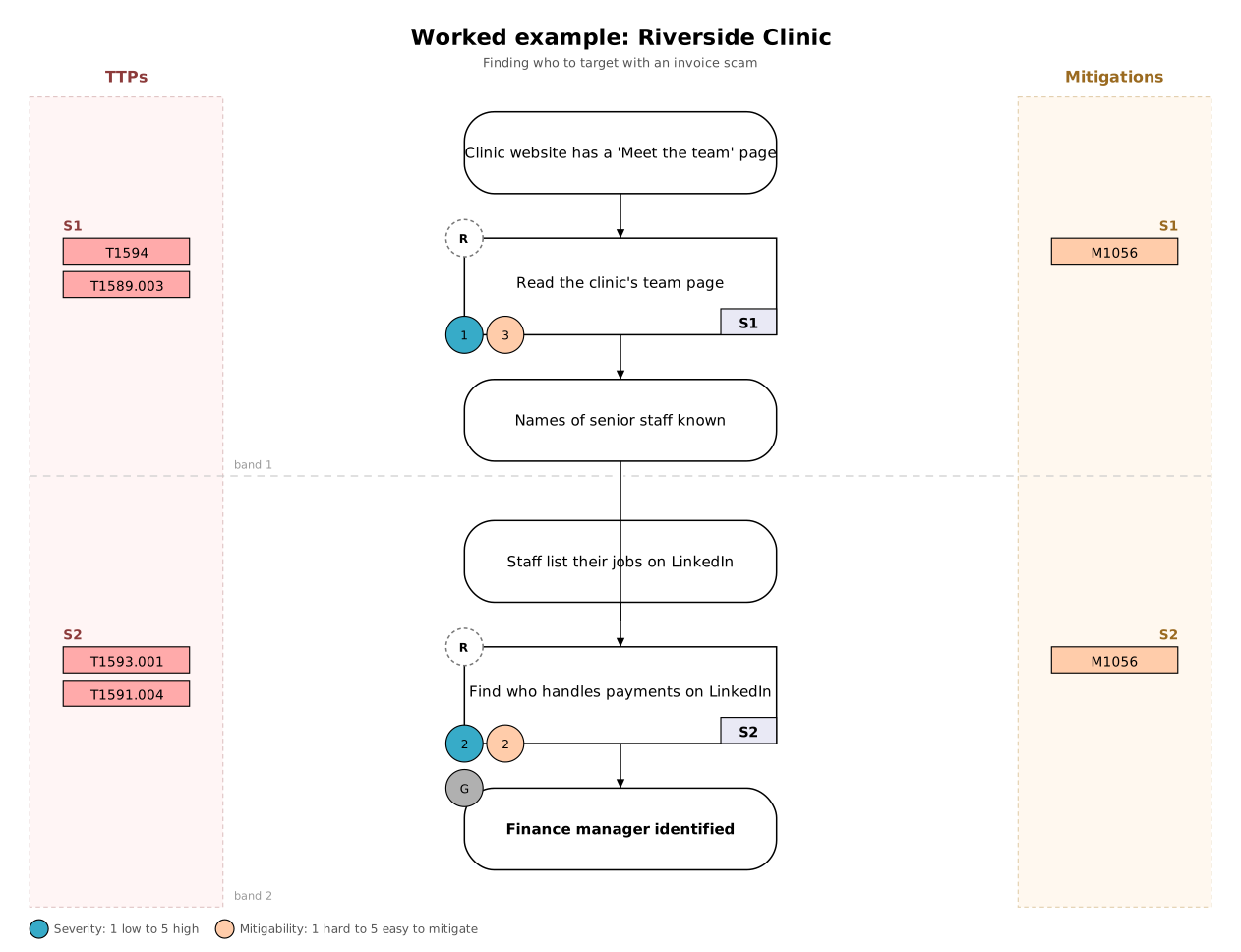
Look at how it's built: the website step is T1594 (Search Victim-Owned Websites), yielding employee names (T1589.003). The LinkedIn step is T1593.001 (Social Media), yielding roles (T1591.004). Both mitigations are M1056, and the scores are low for severity and low for mitigability.
Each task opens in the builder with the scenario beside your graph. Build your graph, press Check my graph for feedback as often as you like, and then compare with the model answer. Your work on each task is saved in your browser separately from your other graphs.
An investigation has worked out how an attacker researched a university lab. Model the five reconnaissance steps accurately.
Think like an attacker: map the different ways someone could learn who to phish and how to get in remotely.
When you've finished, you can send your graph and its activity log to your tutor with Email to tutor in the builder.